What a House Overlay Actually Means (and What It Doesn't)
Most synastry reports list house overlays like ingredients in a recipe — Venus in your 5th, Mars in your 7th, Moon in your 4th — without explaining what you're supposed to do with that information. The result: you skim past them looking for aspects, the dramatic conjunctions and oppositions that sound like they mean something.
Here's what those reports don't tell you: house overlays show WHERE your partner's energy lands in your life. Not how it feels (that's aspects), but where it shows up. Your partner's Venus in your 5th house means their affection, aesthetic sense, and way of loving activate your romance sector — the part of your chart that governs dating, creativity, and spontaneous joy. That's not the same as Venus trine your Sun (which describes a harmonious flow between your core identities). The overlay tells you what DOMAIN of your life lights up when they walk into the room.
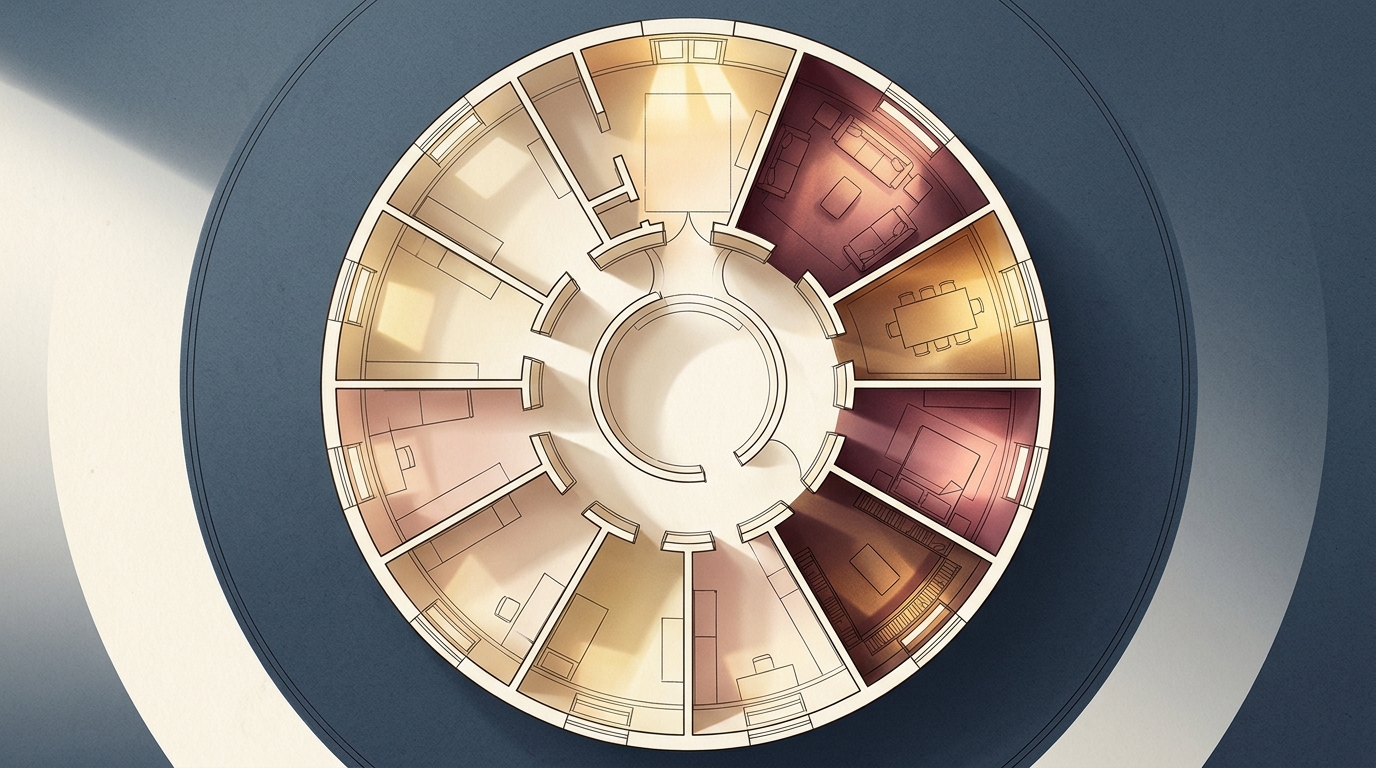
Think of your natal chart as a house with twelve rooms. Each room serves a different function: one for partnership, one for home life, one for sex and shared resources, one for daily routine. When someone's planets land in your rooms, they become part of that space. They rearrange the furniture. They change the lighting. Sometimes they make a room you've ignored suddenly feel essential.
The distinction matters because aspects without context are just weather patterns — pleasant or tense, but directionless. Overlays give the weather a location. Your partner's Mars square your Venus might create friction, but if that Mars lands in your 7th house, the friction shows up in how you approach commitment. If it lands in your 10th, it shows up in how they influence your career ambitions or public image. Same aspect, different life domain, entirely different relationship dynamic.
House overlays are positional, not angular. They don't measure the geometric relationship between planets — they measure WHERE in your chart architecture your partner's planets sit. This is why two people can have similar aspect patterns but wildly different relationship experiences: the overlays place those aspects in different rooms of the house.
The Ascendant Overlay: Why First Impressions in Synastry Are Rarely Accidental
The Ascendant isn't a planet — it's the degree of the zodiac rising on the eastern horizon at your birth. It's the front door of your chart, the threshold between your inner world and how you present yourself. When someone's planets land on or near your Ascendant, they affect how you show up in the world when they're around.
Ascendant synastry affects first impressions and physical attraction in ways that feel immediate and non-negotiable. If their Sun conjuncts your Ascendant, you feel seen in their presence — not just acknowledged, but recognized at a core level. They mirror something essential about your self-expression. If their Venus lands there, you feel attractive, desired, noticed. If their Mars lands there, you feel energized, challenged, sometimes provoked. The Ascendant overlay is the entry point for how their energy enters your life.
This is why some people walk into a room and you just... notice them. Not because they're objectively more attractive or charismatic than anyone else, but because their planets are activating your Ascendant. Your nervous system registers their presence before your conscious mind catches up. That's not mystical — it's positional astrology doing what it does: showing you where energy concentrates.
The reverse matters just as much. When YOUR planets land on someone else's Ascendant, you become part of their self-concept. You influence how they see themselves, how they move through the world, what they project. This can be flattering (your Venus on their Ascendant makes them feel more graceful, more beautiful) or destabilizing (your Saturn there makes them question their identity, feel self-conscious). Either way, you're not a neutral presence. You're in the front hallway of their psyche.
A common pattern in long-term relationships: one person's Sun or Venus conjuncts the other's Ascendant, and the other person's Moon or Venus conjuncts the first person's Ascendant. Mutual activation. Both people feel more themselves AND more seen when they're together. That's the Ascendant overlay functioning as a compatibility anchor — not the only factor that matters, but often the first one that draws people in.
Without Ascendant activation, relationships can feel intellectually compatible but physically flat. You like each other's minds, respect each other's values, but there's no magnetic pull. The Ascendant overlay is where chemistry lives — not the only place, but the most immediate one.
The Five House Overlays That Define Romantic Compatibility
Out of twelve houses, five show up consistently in relationships that last. Not because the others don't matter (they do, for friendship, work partnerships, creative collaboration), but because these five govern the domains that romantic relationships actually occupy: attraction, partnership structure, intimacy, emotional safety, and hidden connection.
You can have a relationship without all five activated. But when you're trying to understand why a relationship feels easy in some areas and impossible in others, these are the overlays to check first.
5th House: Where Attraction Lives
The 5th house governs romance in its most literal sense: dating, flirtation, the early stages of attraction before things get serious. It's also creativity, play, spontaneous joy, and the part of you that wants to have fun without a plan. When someone's planets land in your 5th house, they activate that part of your life.
Their Venus in your 5th: You find them attractive in an uncomplicated way. They're fun to be around. You want to date them, in the traditional sense — dinner, movies, weekends away, the courtship phase. This is the overlay that makes someone feel like a romantic interest rather than a friend or a project.
Their Sun in your 5th: They make you feel playful, creative, lighter. You laugh more around them. You take yourself less seriously. This is the person you want to travel with, try new restaurants with, stay up late with just because you're having a good time. The risk: if the relationship never moves past the 5th house energy, it stays in the dating phase forever. Fun, but not deep.
Their Mars in your 5th: Physical attraction, often immediate. You want to flirt with them, touch them, compete with them in playful ways. This overlay has heat. It can also burn out quickly if there's no deeper connection — Mars in the 5th is about desire, not commitment.
The 5th house overlay is necessary for romantic relationships, but not sufficient. You need this energy to feel attracted and engaged, but if it's the ONLY overlay that's strong, the relationship struggles to mature. You're dating, but you're not building a life.
7th House: Where Partnership Is Activated
The 7th house is the partnership house: marriage, committed relationships, one-on-one bonds that involve mutual obligation. It's not about fun (that's the 5th) or sex (that's the 8th) — it's about showing up as a team, making decisions together, being seen as a unit by the outside world.
When someone's planets land in your 7th house, you see them as partner material. Not just someone you're attracted to, but someone you could build a life with. The synastry 7th house overlay is one of the clearest indicators of long-term compatibility, because it activates the part of your chart that's designed for sustained partnership.
Their Sun in your 7th: You see them as an equal, a counterpart. They feel like the kind of person you're supposed to partner with — not in a soulmate sense, but in a practical, structural sense. You can imagine introducing them to your family, making joint decisions, sharing a bank account. This overlay makes commitment feel natural rather than forced.
Their Venus in your 7th: You find their way of relating harmonious and appealing. They treat you the way you want to be treated in a partnership. There's ease here, a sense of compatibility that doesn't require constant negotiation. This is one of the classic marriage overlays — not dramatic, but deeply functional.
Their Saturn in your 7th: This one's complicated. Saturn brings structure, commitment, and seriousness — which sounds good for the partnership house. And it can be: their presence makes you take the relationship seriously, think long-term, commit in ways you might not otherwise. But Saturn also brings restriction, obligation, and sometimes a sense of burden. You feel the weight of the relationship. You can't just walk away easily. This overlay shows up in relationships that last, but not always because they're joyful — sometimes because they're necessary.
The 7th house overlay is where relationships stop being about feelings and start being about function. Do we work as a team? Can we make decisions together? Do we want the same kind of partnership structure? These are 7th house questions. If this overlay is weak or absent, the relationship might feel romantic and intense, but it struggles to become a stable, committed partnership.
8th House: Where Things Get Complicated
The 8th house governs sex, shared resources, psychological intimacy, and the parts of yourself you don't show to most people. It's also death, transformation, and other people's money — the house of merging and loss of boundaries. When someone's planets land in your 8th house, the relationship goes deep quickly. Sometimes too deep.
Their Venus in your 8th: Sexual chemistry, emotional intensity, a desire to merge. This is the overlay that makes people say "I've never felt this way before." You want to know everything about them. You want them to know everything about you. The vulnerability is intoxicating. The risk: this overlay can create obsession, possessiveness, and difficulty maintaining healthy boundaries. Not every relationship needs 8th house energy — but the ones that have it are hard to forget.
Their Mars in your 8th: Sexual intensity, sometimes to the point of volatility. This is passion that feels necessary, urgent, consuming. It's also the overlay that shows up in relationships with power struggles, sexual tension that bleeds into other areas of life, and a sense that the stakes are always high. Mars in the 8th can be thrilling, but it's not restful.
Their Pluto in your 8th: Transformation through relationship. This person changes you, often against your will. They bring up your shadow, your fears, your unresolved psychological material. The relationship feels fated, intense, sometimes unbearable. This is not a light overlay. It's the kind that makes you say, years later, "That relationship broke me open." Whether that's a good thing depends on what you needed to break open.
The 8th house overlay is where relationships become transformative rather than comfortable. If you want depth, psychological intimacy, and sexual connection that feels significant, you need some 8th house activation. But if it's the ONLY strong overlay, the relationship can feel overwhelming, unstable, and difficult to sustain. You need other houses to balance the intensity.
4th House: Where You Feel at Home (or Don't)
The 4th house governs home, family, emotional foundation, and the part of you that needs safety and privacy. It's where you retreat when the world is too much. When someone's planets land in your 4th house, they touch that vulnerable, private space.
Their Moon in your 4th: This is the "I feel safe with you" overlay. They understand your emotional needs without you having to explain them. You can be yourself around them — not the polished, public version, but the version that's tired, uncertain, or just wants to stay home and do nothing. This overlay shows up in relationships that feel like home.
Their Sun in your 4th: They make your private life feel more vibrant. You want to build a home with them, create a shared domestic space, involve them in your family or chosen family. This is the person you can imagine living with long-term — not just cohabitating, but creating a life structure together.
Their Saturn in your 4th: They bring structure and stability to your home life, but also responsibility and sometimes emotional heaviness. This overlay can feel like they're asking you to grow up, take your domestic life seriously, or confront family patterns you've been avoiding. It's grounding, but not always comfortable.
The 4th house overlay is essential for relationships that involve cohabitation, shared domestic life, or long-term emotional security. If this overlay is weak, the relationship might be exciting and passionate, but it doesn't feel like home. You're not sure you could live with this person, share space with them day after day, build a private life together. The 4th house is where you find out if someone feels like family — or just like a visitor.
12th House: The Hidden Intensity Overlay
The 12th house is the house of the unconscious, hidden things, spiritual connection, and dissolution of boundaries. It's also isolation, self-undoing, and the parts of yourself you don't fully understand. When someone's planets land in your 12th house, the connection feels otherworldly, confusing, and hard to articulate.
Their Venus in your 12th: You're drawn to them in ways you can't explain. The attraction feels spiritual, fated, or just... different from other relationships. There's a dreamlike quality to the connection. The risk: the 12th house is the house of illusion. You might be in love with your projection of them rather than who they actually are. This overlay shows up in relationships where you feel deeply connected but also unsure if you're seeing them clearly.
Their Sun in your 12th: They illuminate your unconscious, your hidden fears, your spiritual life. This can be beautiful — they help you access parts of yourself you couldn't reach alone. It can also be destabilizing — you don't always know how you feel about them, or why. The 12th house is the house of what's hidden, so this overlay often creates relationships that feel significant but hard to define.
Their Neptune in your 12th: This is the overlay of soulmate fantasies and spiritual connection — and also confusion, deception (intentional or not), and boundary dissolution. You might feel like you've known them in a past life, or that you're cosmically connected. You might also struggle to see them as they are, rather than as you wish them to be. The 12th house Neptune overlay is intoxicating, but it requires brutal honesty to navigate.
The 12th house overlay is not for everyone. Some people need relationships that feel clear, defined, and grounded in reality. The 12th house is none of those things. But if you've ever felt a connection that seemed to transcend normal relationship dynamics — a sense of recognition, spiritual intimacy, or just a feeling that this person was meant to enter your life — check for 12th house overlays. They're often there.
How to Read Overlays When You Don't Have an Exact Birth Time
House overlays require accurate birth times. The Ascendant moves roughly one degree every four minutes, which means the house cusps shift throughout the day. If you're off by even an hour, your house overlays could be wrong.
But most people don't have exact birth times. Birth certificates often round to the nearest hour or quarter-hour. Some people only know "morning" or "afternoon." Some have no idea at all.
Here's what you can do:
Check if planets are clearly in one house or another. If someone's Venus is at 15° Gemini and your 5th house cusp is at 3° Gemini, that Venus is definitely in your 5th house — even if your birth time is off by an hour. If their Venus is at 2° Gemini and your 5th house cusp is at 29° Taurus, it's probably in your 5th, but you'd need an exact birth time to be sure. The closer a planet is to a house cusp, the more precision you need.
Focus on overlays that don't depend on the Ascendant. If you don't trust your birth time, you can't trust your house cusps. But you CAN look at what sign someone's planets are in, and what sign your planets are in, and get a sense of thematic resonance. This isn't the same as house overlays, but it's better than nothing.
Use the whole-sign house system as a rough guide. In whole-sign houses, each sign corresponds to one house. If your Ascendant is in Leo, your entire 5th house is Sagittarius, your entire 7th house is Aquarius, and so on. This system is less precise than Placidus or Koch, but it's more forgiving of inaccurate birth times. If someone's Venus is in Sagittarius and your Ascendant is in Leo, their Venus is in your 5th whole-sign house — regardless of the exact degree of your Ascendant. It's a blunt instrument, but sometimes blunt instruments are useful.
Rectify your birth time (or pay someone to do it). Birth time rectification is the process of working backward from major life events to narrow down your birth time. It's tedious and requires detailed records of when significant things happened in your life, but it's the only way to get an accurate chart if your recorded birth time is unreliable.
Accept uncertainty. Not every astrological question can be answered with the information you have. If you don't have an accurate birth time, house overlays are speculative. You can read them as possibilities, but you can't treat them as definitive. That's frustrating, but it's honest.
The alternative — reading house overlays with a birth time you know is wrong — is worse than not reading them at all. You'll draw conclusions about where your partner's energy lands in your life, and those conclusions will be based on faulty data. Better to acknowledge the limitation and work with how the aspects between those planets work instead, which don't require accurate birth times.
Why Overlays Need a Human to Interpret Them Properly
Automated synastry reports list house overlays like they're data points: "Their Venus is in your 5th house. This indicates romance and attraction." Technically true, but useless without context.
Here's what the algorithm doesn't tell you:
The condition of the planet matters. Venus in your 5th house sounds romantic, but if that Venus is in Virgo and square Saturn, the romance is cautious, critical, and slow to develop. If it's in Leo and trine Jupiter, the romance is expansive, generous, and confident. The house placement tells you WHERE the energy lands. The sign and aspects tell you HOW it behaves. You need both.
The condition of YOUR 5th house matters. If your natal 5th house is empty and in a sign that doesn't emphasize romance (say, Capricorn), someone's Venus landing there activates a part of your chart that's been quiet. That's different from someone's Venus landing in your 5th house when you already have three planets there — it amplifies existing energy rather than introducing new energy.
Overlays interact with each other. If someone's Venus is in your 5th house (romance) but their Saturn is in your 7th house (partnership), the relationship feels fun and attractive in the early stages, but serious and heavy when you try to commit. That's not a contradiction — it's two different overlays creating two different dynamics. A human reader sees the pattern. An algorithm lists the placements separately and leaves you to figure out how they fit together.
Some overlays are more important for some people. If your natal chart emphasizes the 8th house (lots of planets there, or Scorpio rising), 8th house overlays will feel more significant to you than to someone whose chart emphasizes the 3rd house. Astrology is personal. The same overlay means different things to different people, depending on what their natal chart prioritizes.
Overlays need to be read in the context of the whole synastry chart. A strong 7th house overlay suggests partnership potential, but if the rest of the synastry is harsh (lots of squares and oppositions, no supportive trines or sextiles), the partnership will be difficult even if the 7th house is activated. The overlay shows WHERE the relationship lives. The aspects show HOW it functions. You can't read one without the other.
This is why get your house overlays read by a relationship astrologer rather than relying on a free report. The report gives you the data. The astrologer gives you the interpretation — which overlays matter most for YOUR chart, how they interact with each other, what they mean in the context of the rest of the synastry. That's not something an algorithm can do, because it requires judgment, pattern recognition, and an understanding of what you're actually asking.
You're not asking "What are my house overlays?" You're asking "What do these overlays mean for this relationship, given who I am and what I need?" That's a human question. It requires a human answer.