Why the Aspect Type Is Only Half the Answer
You've pulled up a synastry chart. The software spits out a list: Venus square Mars, Moon trine Sun, Saturn conjunct Mercury. And next to each one, a little blurb — "challenging," "harmonious," "karmic." The problem? That list treats every square like it does the same thing. Every trine like it's automatically good news.
Here's what actually happens: A Venus-Mars square creates sexual tension that can sustain a relationship for years. A Moon-Sun trine can breed emotional complacency where nobody grows. The aspect type — conjunction, trine, square, opposition — tells you the mechanism. But the planets involved and the houses they occupy determine whether that mechanism builds something or burns it down.
Most synastry interpretations stop at the aspect name. They give you a verdict: "This is hard." "This flows easily." What they don't tell you is that "hard" aspects often generate the friction that keeps two people magnetically locked in, while "easy" aspects can leave a relationship feeling pleasant but forgettable.
The central thesis here: aspect type is information, not destiny. A square between two charts isn't a red flag. It's a description of how energy moves between you. Whether that movement creates passion or poison depends entirely on which planets are involved, what they rule in each person's chart, and whether both people have the emotional range to work with intensity.
This article walks through the four major aspects — conjunction, trine, square, opposition — and shows you how to read them in context. Then we'll look at the aspects most people misread entirely: Saturn (the "bad" planet that actually holds relationships together), Chiron (the wound that won't stop surfacing), and Black Moon Lilith (the one nobody discusses honestly). By the end, you'll stop treating aspects like verdicts and start reading them like the complex, layered information they actually are.
The Four Major Aspects and What They Actually Do in a Synastry Chart
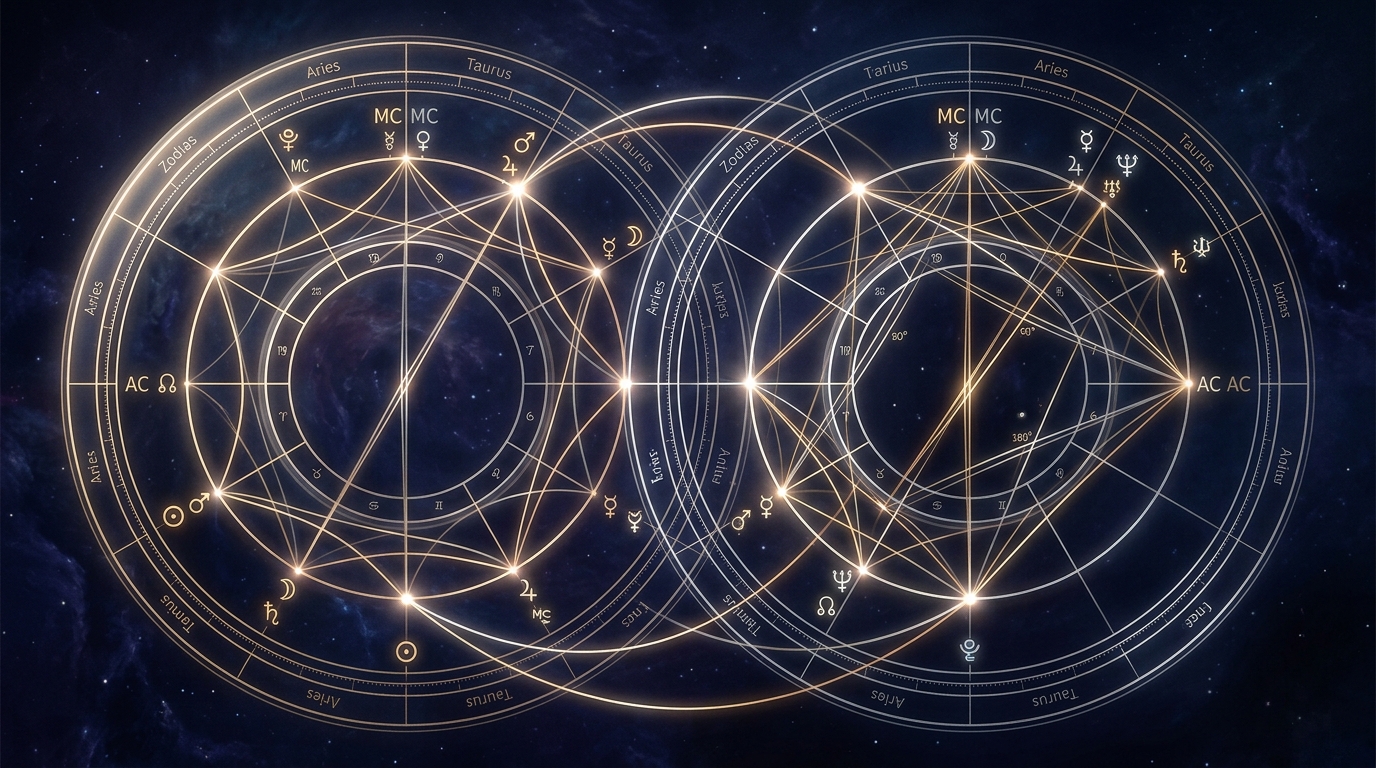
Aspects describe the angle between two planets in a synastry chart. When your Venus sits 90 degrees from someone's Mars, that's a square. When your Moon is 120 degrees from their Sun, that's a trine. The angle determines how the planetary energies interact — whether they blend, clash, amplify, or pull in opposite directions.
But here's the critical distinction: the aspect describes the mechanism, not the outcome. A trine creates ease. A square creates friction. What you do with that ease or friction — that's where the actual story lives.
Conjunction: Intensity That Can Go Either Way
A conjunction occurs when two planets occupy the same degree (or within 8-10 degrees of each other). In synastry, this means one person's planet lands directly on top of another person's planet. The energies merge completely.
What it actually does: Conjunctions amplify. If your Venus conjuncts someone's Mars, your receptivity and their drive occupy the same psychic space. There's no separation, no breathing room. You feel each other intensely. This can manifest as instant chemistry — or as two people who trigger each other relentlessly.
The key variable: which planets are conjunct.
- Sun conjunct Sun: You see the world similarly. Same ego structure, same sense of identity. This can feel like meeting your twin — or like dating yourself (which gets boring).
- Moon conjunct Moon: Emotional rhythms sync perfectly. You instinctively understand each other's needs. The downside? No emotional contrast. If both of you shut down under stress, nobody's there to pull the other out.
- Venus conjunct Mars: Classic sexual magnetism. One person's desire (Mars) meets the other's receptivity (Venus) with zero distance. This aspect alone can sustain physical attraction for years, even when everything else falls apart.
- Mercury conjunct Mercury: You think alike. Conversations flow. But if you're both overthinkers, you'll spiral together. If you're both conflict-avoidant, nothing ever gets said.
Conjunctions are intense because there's no modulation. The energies don't negotiate — they fuse. Whether that fusion feels electric or suffocating depends on whether both people want that level of merger in that area of life.
Trine: Ease That Can Become Complacency
A trine is a 120-degree angle. In synastry, it means the planets fall in compatible elements (fire with fire, earth with earth, air with air, water with water). Energy flows easily between them.
What it actually does: Trines remove friction. If your Moon trines someone's Venus, emotional expression (Moon) and affection (Venus) align naturally. You don't have to work to understand each other. It just... happens.
This sounds ideal. And in many ways, it is. Trines create the comfort people crave in long-term relationships. But here's the trap: ease doesn't always equal growth.
Consider a Sun-Moon trine. One person's core identity (Sun) harmonizes effortlessly with the other's emotional needs (Moon). You "get" each other without trying. But if neither person is pushed to articulate what they need, or challenged to see outside their own perspective, the relationship can plateau. It feels good, but it doesn't go anywhere.
Trines work best when:
- At least one person brings enough self-awareness to avoid coasting
- The relationship includes some squares or oppositions to generate necessary tension
- Both people value ease and aren't looking for constant intensity
Trines are underrated in their capacity to sustain relationships through difficult external circumstances (career stress, family crises, financial strain). When life gets hard, having a few trines in your synastry chart means you're not also fighting each other. But if the entire chart is trines? You might wake up five years in and realize you've been comfortable, but not particularly alive.
Square: Friction That Often Fuels Attraction
A square is a 90-degree angle. The planets involved are in incompatible elements (fire-water, earth-air). Energy doesn't flow — it collides.
What it actually does: Squares create tension. But tension isn't inherently destructive. In fact, squares are often the aspects that generate the most aliveness in a relationship. The friction keeps both people engaged.
Example: Venus square Mars. One person's way of giving affection (Venus) rubs against the other's way of pursuing what they want (Mars). This can manifest as arguments about how to show love, or as sexual tension that never quite resolves. It's uncomfortable. It's also magnetic.
Here's what most synastry interpretations miss: squares force both people to articulate what they need. In a trine, you don't have to explain yourself — the other person just gets it. In a square, you have to communicate, negotiate, and sometimes fight for what matters to you. That process — when both people are emotionally mature enough to engage with it — builds intimacy.
Squares that often define a relationship's most electric quality:
| Square | What It Creates | Why It Works |
|---|---|---|
| Venus-Mars | Sexual tension, desire that doesn't resolve easily | Keeps physical attraction alive long-term |
| Moon-Sun | Emotional needs clash with core identity | Forces both people to grow beyond their defaults |
| Mercury-Mercury | Different communication styles, frequent misunderstandings | When resolved, creates deeper understanding than easy agreement |
| Mars-Mars | Competing drives, power struggles | Channels into shared ambition or passionate arguments (sometimes both) |
The failure mode of squares: when one or both people lack the emotional bandwidth to work with intensity. If every disagreement feels like a threat, squares become exhausting. But if both people can tolerate discomfort and see conflict as information rather than danger, squares are often the aspects they remember most fondly years later.
Opposition: The Push-Pull That Keeps You Hooked
An opposition is a 180-degree angle. The planets sit directly across from each other in the chart. In synastry, this creates a see-saw effect: when one person leans into their planet's energy, the other feels pulled toward the opposite pole.
What it actually does: Oppositions generate polarity. You're attracted to what the other person represents because it's the energy you lack (or suppress) in yourself. But that same polarity creates tension — you're drawn to each other and you drive each other crazy.
Example: Sun opposite Moon. One person's core identity (Sun) sits opposite the other's emotional needs (Moon). The Sun person feels fully themselves in ways the Moon person finds destabilizing. The Moon person's emotional depth feels overwhelming to the Sun person. And yet — they're magnetically drawn to each other because each represents what the other is missing.
Oppositions are the aspect of projection. You see in the other person the qualities you've disowned in yourself. Early in the relationship, this feels like fascination. Later, it can feel like criticism: "Why are you always so [insert quality]?" The quality you're criticizing is often the one you're attracted to — and the one you refuse to develop in yourself.
Oppositions that create long-term pull:
- Venus-Mars opposition: Classic attraction of opposites. One person's receptivity opposes the other's assertion. Sexually charged, often contentious.
- Moon-Moon opposition: Emotional needs sit at opposite ends of the spectrum. One person needs closeness when the other needs space. Requires constant negotiation.
- Mercury-Mercury opposition: You think in opposite ways. What's obvious to one is invisible to the other. Can be maddening or enlightening (usually both).
The gift of oppositions: they show you the parts of yourself you've been avoiding. The challenge: that confrontation is uncomfortable, and most people would rather blame their partner than integrate the lesson.
Saturn Aspects: The Most Misread Influence in Synastry
Saturn gets a bad reputation in synastry. It's the planet of restriction, limitation, and cold reality. When someone's Saturn touches your personal planets (Sun, Moon, Venus, Mars, Mercury), the instinct is to run. "This will be heavy." "They'll hold me back." "Saturn = bad."
Here's what that reading misses: Saturn aspects create long-term stability or restriction in relationships — and which one you get depends entirely on whether both people are willing to do the work Saturn demands.
Saturn doesn't make things easy. It makes things real. And in a culture that confuses ease with compatibility, Saturn aspects get misread as problems when they're often the glue holding a relationship together through everything else.
Saturn Conjunct or Trine a Personal Planet: Structure, Not Prison
When someone's Saturn conjuncts or trines your Sun, Moon, Venus, or Mars, they bring structure to that area of your life. If it's your Moon, they help you regulate your emotions. If it's your Venus, they ground your affection in something tangible. If it's your Mars, they give your drive a sustainable framework.
This doesn't feel romantic in the early stages. Saturn energy is cooling. It's the person who says, "That's a great idea — now how are you actually going to do it?" It's the one who doesn't let you spiral into fantasy or avoid difficult conversations.
But here's what happens over time: Saturn conjunctions and trines are the aspects that keep people together when the initial infatuation fades. They create commitment — not as a prison, but as a choice both people keep making because the relationship is built on something more durable than chemistry.
Real-world example: Saturn conjunct Venus. The Saturn person doesn't shower the Venus person with effusive affection. They show love through consistency — showing up, following through, building something together. For someone whose Venus craves grand gestures, this can feel disappointing. For someone who's been burned by people who promise everything and deliver nothing, it's exactly what they need.
Saturn Square or Opposite a Personal Planet: When 'Challenging' Means Something Real
Saturn squares and oppositions are where the reputation comes from. These aspects create friction. The Saturn person feels critical, restrictive, or withholding to the other person. The other person feels irresponsible, immature, or avoidant to the Saturn person.
And yet — these are often the aspects that define the most significant relationships of someone's life.
Why? Because Saturn squares and oppositions force growth. They surface the places where you're avoiding responsibility, clinging to immaturity, or refusing to build something sustainable. The Saturn person becomes the mirror showing you what you don't want to see.
Example: Saturn square Moon. The Saturn person's presence makes the Moon person feel emotionally unsafe — like their feelings are being judged or dismissed. The Moon person's emotional intensity makes the Saturn person feel overwhelmed or manipulated. Neither is wrong. They're just operating from different emotional frameworks.
If both people can tolerate the discomfort, this aspect builds emotional maturity. The Moon person learns to regulate their emotions and communicate needs clearly. The Saturn person learns to soften, to meet emotion with presence rather than logic. But if either person is looking for ease, this aspect will feel like punishment.
Saturn aspects aren't for everyone. They require both people to value growth over comfort. But for people who want a relationship that lasts — through career changes, family crises, and the inevitable erosion of early-stage chemistry — Saturn aspects are often the ones doing the heavy lifting. If you're serious about understanding how Saturn functions in long-term compatibility, it's worth studying these dynamics in depth.
Chiron Aspects: Where the Relationship Heals You (and Where It Hurts)
Chiron is the "wounded healer" in astrology. It represents the place you were hurt early, the wound that never fully closes, and paradoxically, the place where you have the most capacity to heal others.
In synastry, Chiron synastry reveals healing and wounding dynamics. When someone's planet touches your Chiron, they activate that wound. When your planet touches their Chiron, you become the person who either soothes or aggravates their deepest hurt.
This isn't comfortable. Chiron aspects don't create ease or flow. They create recognition — the eerie feeling that this person sees the part of you that you've spent years trying to hide.
What Chiron aspects actually do:
Chiron aspects bring the wound into the relationship. If your Chiron is conjunct someone's Venus, your core wound around worthiness or rejection gets activated every time they express affection. If their Mars squares your Chiron, their assertion or anger triggers the place where you learned to suppress your own needs.
The gift: Chiron aspects offer the possibility of healing through relationship. Not because the other person fixes you, but because they create the conditions where the wound surfaces — and in surfacing, can finally be metabolized.
The trap: Most people aren't prepared for this level of emotional exposure. When the wound gets activated, the instinct is to blame the other person: "You make me feel [inadequate/invisible/too much]." The other person didn't create the wound. They just showed you where it lives.
Chiron aspects that show up most in significant relationships:
- Chiron conjunct Sun: The Chiron person feels seen by the Sun person in a way that's both healing and excruciating. The Sun person represents what the Chiron person feels they can never be.
- Chiron conjunct Moon: Emotional wounds surface. The Moon person's needs trigger the Chiron person's deepest hurt around being cared for (or not cared for).
- Chiron conjunct Venus: Wounds around worthiness, rejection, and being loved. The Venus person's affection activates the Chiron person's belief that they're unlovable.
Chiron aspects require both people to have done enough inner work that they can separate wound from person. If you're still unconsciously looking for someone to heal you, Chiron aspects will feel like betrayal when the other person inevitably can't. But if you're willing to own your wound and do the work of healing it yourself, Chiron aspects can mark the relationships where you finally integrate the parts of yourself you've been running from.
For a deeper exploration of how this plays out, see Chiron in Synastry: The Wound That Keeps Showing Up in Your Relationships.
Black Moon Lilith in Synastry: The Aspect Nobody Talks About Honestly
Black Moon Lilith represents the part of you that refuses to be tamed. It's your raw, undomesticated desire. The place where you won't compromise, won't perform, won't make yourself smaller to fit someone else's expectations.
In synastry, Lilith aspects surface the parts of the relationship that feel taboo, transgressive, or socially unacceptable. This is the aspect that makes people uncomfortable — which is exactly why it's worth paying attention to.
What Lilith aspects reveal:
When someone's planet touches your Lilith, they activate your wildness. They see the part of you that doesn't play by the rules. And their response to that wildness — whether they're fascinated, repelled, or trying to control it — tells you everything you need to know about whether the relationship has room for your full self.
Example: Venus conjunct Lilith. The Venus person is drawn to the Lilith person's raw, unfiltered desire. But Venus also wants harmony, beauty, socially acceptable affection. The Lilith person doesn't care about any of that. This creates a push-pull: attraction mixed with the Venus person's discomfort at how much the Lilith person refuses to perform.
Lilith aspects that create the most intensity:
- Mars conjunct Lilith: Sexual chemistry that feels slightly dangerous. Mars wants to conquer; Lilith refuses to be conquered. The result is often a power dynamic that's electric and unstable.
- Sun conjunct Lilith: The Sun person is fascinated by the Lilith person's refusal to conform. But the Sun also wants to be the center — and Lilith won't orbit anyone.
- Moon conjunct Lilith: Emotional needs meet primal desire. The Moon person wants safety and nurturance. The Lilith person wants freedom and raw honesty. Rarely compatible long-term unless both people have high tolerance for discomfort.
Lilith aspects aren't for people looking for stability. They're for people who want to be fully seen — including the parts that don't fit into conventional relationship scripts. The challenge: most people say they want that, but when confronted with someone who actually refuses to perform, they panic.
If you have strong Lilith aspects in your synastry chart, the question isn't "Is this good or bad?" It's "Am I willing to let this person see the parts of me I usually hide?" And equally: "Can I handle seeing those parts in them?"
How to Read Multiple Aspects Together — Not One at a Time
Here's where most synastry readings fall apart: they treat each aspect as an isolated data point. "You have Venus trine Mars — that's good. You have Moon square Saturn — that's hard." Then they add it up: more trines than squares = compatible. More squares than trines = difficult.
This is like reading a novel one sentence at a time, in random order, and trying to understand the plot.
Aspects don't exist in isolation. They form patterns.
When you read a synastry chart, you're looking for:
Dominant themes: Do multiple aspects point to the same dynamic? If you have Venus square Mars, Mars opposite Moon, and Mars conjunct Lilith, the Mars person's assertion is a central theme in this relationship. It's creating friction in multiple areas. That's not a bug — it's the story.
Counterbalances: A difficult aspect becomes workable when there's an easier aspect involving the same planets. Moon square Sun is challenging — but if you also have Moon trine Venus, there's an emotional safety net. The Venus connection gives you a way back to each other after the Sun-Moon tension flares.
Reinforcement: When the same theme shows up through different planetary combinations, pay attention. If you have Sun conjunct Moon, Venus trine Mars, and Mercury sextile Mercury, the message is clear: this relationship works because you're fundamentally aligned. The specific aspects are less important than the pattern they create.
Outliers: Sometimes one aspect stands out because it's the only difficult one in an otherwise harmonious chart — or the only harmonious one in an otherwise tense chart. That outlier often becomes the make-or-break factor. A single Venus-Saturn square in a chart full of trines can be the thing that either grounds the relationship or kills it, depending on how both people relate to Saturn's demand for structure.
Example synthesis:
Let's say you have:
- Sun trine Moon (emotional ease, core compatibility)
- Venus square Mars (sexual tension, friction around affection)
- Mercury conjunct Mercury (you think alike)
- Saturn conjunct Venus (the Saturn person grounds the Venus person's affection)
What's the story? You have fundamental compatibility (Sun-Moon trine) and intellectual alignment (Mercury conjunction). But there's sexual tension that doesn't resolve easily (Venus-Mars square), and the relationship has a serious, committed quality that might feel restrictive to the Venus person (Saturn-Venus conjunction).
This is a relationship where you get each other, you think alike, and there's long-term potential — but the Venus person might chafe against how serious it feels, and the sexual dynamic requires ongoing negotiation. Neither the tension nor the ease defines the relationship. Both are true simultaneously.
That's the skill: holding multiple truths at once. Not reducing the relationship to "compatible" or "incompatible," but seeing the specific texture of how these two people move through the world together.
What a Specialist Sees That an Automated Report Misses
Automated synastry reports give you a list. Planet A in aspect to Planet B. A paragraph of interpretation. Maybe a compatibility score.
What they don't give you:
Context. A Mars-Saturn square means something entirely different for someone whose natal chart is full of fire (they need the Saturn person's grounding) versus someone whose natal chart is heavy in earth (the Saturn person might feel redundant or oppressive).
House overlays. An aspect tells you how two planets interact. But the house overlay tells you where that interaction plays out in your life. Venus trine Mars is lovely — but if that Mars falls in your 12th house, the attraction might feel secret, hidden, or somehow unavailable. The aspect is easy; the house placement adds complexity. To understand how house overlays shape aspect interpretation, see Synastry House Overlays: Which Houses Actually Matter for Romantic Compatibility.
Timing. Some aspects matter more at different life stages. A Saturn square might feel unbearable in your twenties when you're still figuring out who you are. The same aspect in your forties, when you value stability and commitment, might be exactly what you need.
The individual's relationship to their own chart. If someone has a natal Moon-Saturn conjunction, they're already familiar with Saturn's emotional restriction. When they encounter it in synastry, it's not foreign — it's resonant. But if someone has a natal Moon-Jupiter trine (emotional ease, optimism), a partner's Saturn square their Moon will feel like a shock to the system.
The question behind the question. When someone asks, "Is this relationship going to work?" they're usually asking something more specific: "Will this person hurt me the way the last one did?" or "Can I trust this, or am I fooling myself?" or "Is the difficulty I'm feeling a sign to leave, or a sign to stay and grow?" A list of aspects can't answer that. A human who understands the nuance of synastry — and who asks the right follow-up questions — can.
This is why talking to a synastry specialist about your specific aspects often reveals dynamics that no automated report can surface. The aspects are the same. The interpretation — when it accounts for context, history, and what you're actually trying to build — becomes something entirely different.
Synastry isn't a verdict. It's not a compatibility score or a prediction. It's a map of how two people's energies interact — where they flow, where they clash, and where the friction might be the most interesting part of the whole thing. The aspects tell you the mechanism. What you do with that information is up to you.